
468x60 Ads

Showing posts with label Photography. Show all posts

Friday, February 1, 2013

Malta

Malta: A Mediterranean splendor
Ghana Bay
Ghana Bay Malta


When our flight reached the Maltese airspace, I saw a splendid view of a small island surrounded by the Mediterranean Sea. The northern side of the island showed two outcrops and an edgy tapering to the North. Just at some distance from the main island were two smaller islands called Comino and Gozo.
The plane landed and we reached the hotel in time for lunch and had the second half of the day for work. From a geologist's perspective, this place is quite interesting, as the whole island is basically a massive calcium carbonate rock.
 Malta is a small island country. It had been an English naval base during the Second World War, so most of the population here speaks English. The whole country can be traveled length and breadths in a day and is a good scale model to study island bio-geography. 
To understand the present-day geological and geo-chemical setting of Malta, it is essential to know the history of this land in terms of it's land use. Geographically, Malta is in the center of the Mediterranean Sea. It has undergone three war sieges in it's history. It's initial inhabitants included Roman and Arabic people. Maltese, as a language is a mix of both. In terms of heritage, Malta has many beautiful churches, and was one of St John’s bases on his voyages. Malta also hosts a beautiful St. Paul’s cathedral, which is worth a visit.  Through the years, main occupation here used to be agriculture. The vegetation here can be categorized as Mediterranean scrub vegetation.
 Initially, the island constituted of small freshwater streams, but there are none present now. People used up all the terrestrial freshwater for farming and domestic purposes in the past. They then turned to groundwater sources. To support the island population, more water was necessary and ground water abstraction increased to a substantial level. To this note it should also be mentioned that due to over abstraction of groundwater in the past, the entire country does not have any natural freshwater sources left. It is entirely reliant on desalination for its freshwater needs. There are about 4 desalination plants and there is extensive research going on to refine desalination process. Malta has one of the world’s highest population densities. Population here is not the count but amount of people per square acre. The government levies a forty percent surcharge on every taxpayer for freshwater production. They have a saying in Malta “whatever is yellow treat it like mellow, whatever is brown flush it down”. It shows the need and scarcity of water. Being small, this island also faces an issue with it's waste disposal as land filling is not an option. From an earth scientist's point of view, Malta is a good scale model of ecosystem problems. It really made me wonder that these problems in the real sense are going to be our problems soon as our earth no different  than a bigger island in the unknown space. 


A shot from the tip of Ghana Bay.
In a normal functioning, the aquifer would run out of water when over abstracted, but as this island is a massive Calcium Carbonate rock it acted like a sponge and refilled itself with all the surrounding sea water. The ground water got mixed with sea water and when it was abstracted and used for domestic purposes most of the land under agriculture was salinized. Unlike normal beaches most of Southern Maltese beaches are rocky. All throughout the coast line is beautiful, with many coves and clear water with shades of blue and turquoise. It is a tourist hot-spot and offers good holiday environments. It is rivaled by Greece and Cyprus for Mediterranean tourism. Nonetheless it must be complimented for its exceptional Mediterranean food and very hospitable people. Something really noteworthy about Malta is that it is easily navigable. One can cycle or take a bus all over. Majority of the buses in Malta are the 'Routemasters' which gives the place a classic touch. 
Golden bay and the Ghana Bay are two must-see beaches in Malta. Both the sites hold great prospects for tourists as well as Earth Scientists. There are excellent openings for scuba diving. The Fungus Rock and Dwejra Bay on Gozo are really noteworthy in this respect.

Fungus Rock Gozo Island.
But even with all the political and economic storms ahead there is a huge blue horizon to look forward to. 

I really enjoyed my stay and research in Malta, and I hope to see it again sometime in the future. There was a lot to take away in terms of experiences, from the depths of the sea to depths of the problems this country faces. 


Wednesday, January 30, 2013

Photography: A techno-art, basics of image composition.

Vision is a priceless gift and ability we are addicted to. We are highly addicted to this sense and sometimes take it for granted. Photography is a technology which really sheds light as it makes you think  “how hard do you have to try to get something scenically-beautiful as a scene in a machine!!!” but this struggle is the key for developing the skill of photography. This skill has two benefits one of which is obvious and the second one is not. The obvious one is that you try to develop good photographs for the enjoyment of yourself and others but in the shadow of this you start looking for good shots. You look at any scene or any view in closer details, finding the source of light, the direction, the direction of wind and even your own orientation.  These things become an involuntary part of your thinking process which is why I like to call photography as an iterative skill as more you try to develop it, it in-turn develops you. You get more imaginative and creative with not plain vision but thoughts that can paint your vision.

In this article is shall be focusing on basic things which you need to look for to lay a good foundation of photography. To start with it is highly important that you are in coherence with the scene in front of you. Take a minute or two to admire the scene and store in your head. Remember only if you appreciate the scene then the viewers can appreciate it. Build a thought in your head so as to make decision of whether you like the scene and wish to capture it as it is or weather you would like to see some specifics of the scene and omit a few things. This step is what decides how your photograph will finally turn out for you and the viewers. Once you have done this, see the direction of the light which is incident on the scene overall. Then have a look at how you would like to orient your photo i.e. how would you like to see it when it comes out!!! Imagine the photo in frame or as desktop wallpaper and see if you would like it, and this where your thought process rounds off and you are ready to take the picture. Position yourself in the best angle to capture the scene and then think of the light conditions;
  1. Look at the aperture values of your camera settings (usually denoted as F value).

  2. See the Shutter speed (usually denoted as S).

  3. See the Exposure values (Usually denoted with a +- sign on the camera).

  4. The see the metering and focus point of where your lens is pointing.
These four steps lay the foundation of any image. From the previous blog you would know that the lens aperture controls the amount of light coming on the sensor. Like the coronary action of human eye this number is measured in diameter units and is given by the F value.

The shutter speed works basically like the way human eye blinks to save any image. The shutter release button triggers the shutter inside which closes and saves the incident light on the sensor which is then processed to form an image.

The exposure value is like slitting your eyes to see more carefully, i.e. it basically controls the light exposure on the image sensor making the image under exposed (dark) or over exposed (light). This maneuvering helps to tone the image for a balance of shadows verses highlights.

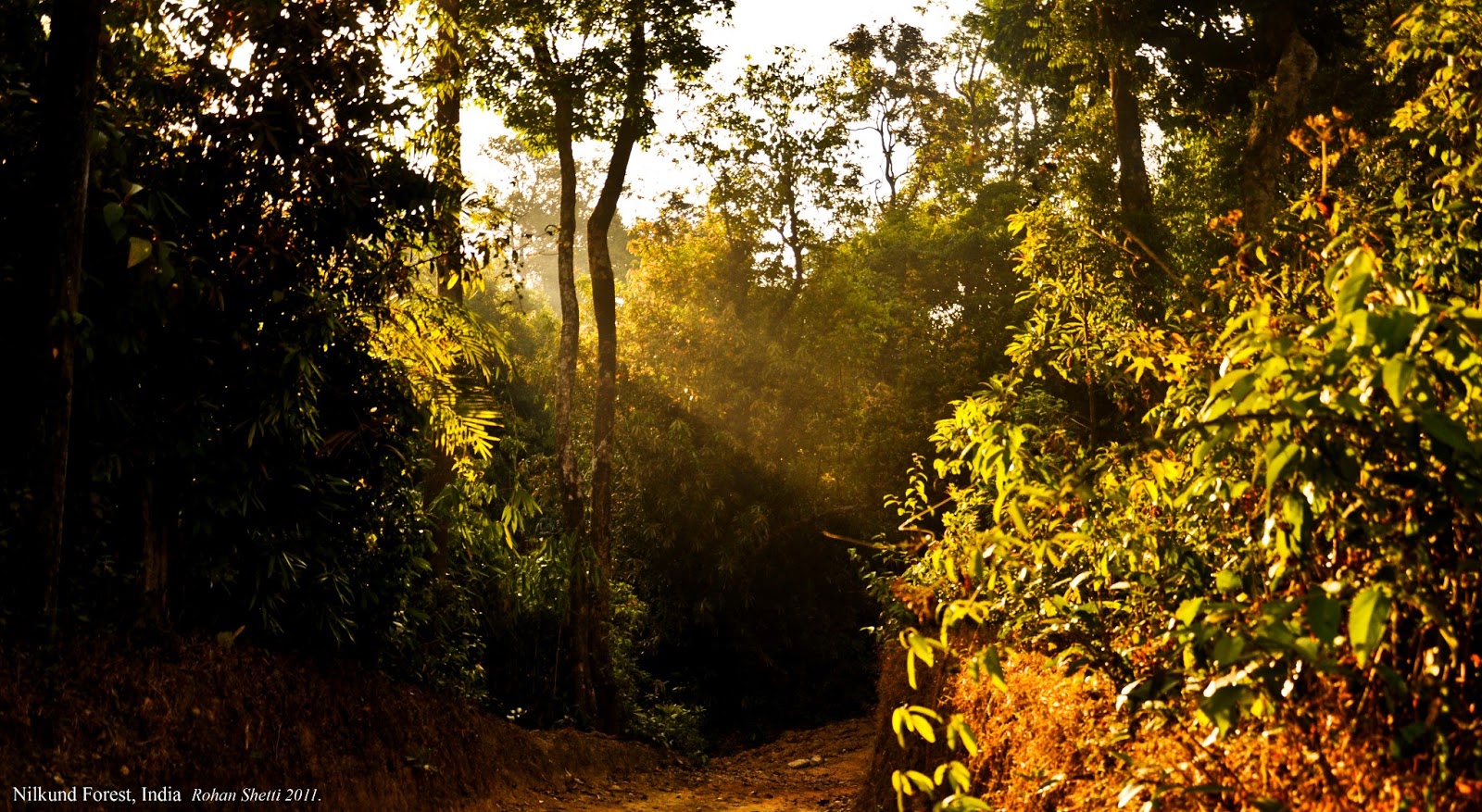
Just to give an illustration, have a look at the image below:


The meta-data of this image is as follows:
  • F stop: f: 4.2 (A moderately high aperture value)
  • Shutter speed: 1/ 160 sec
  • Exposure bias: - 1.3 ev.
  • Focal Length: 32m

The image is shot in the Indian Rainforest; to show the significant sun rays it is important to have reduced sky highlights and enhancing shadows. Only then the rays breaking through the vegetation are clearly prominent. This shows that to have a well composed image it is important to know what you want to show the viewers and so equally important to note what you don’t want them to see or what might divert their attention in the image.

There is a saying in photography "It takes a lot of imagination to be a good photographer. You need less imagination to be a painter, because you can invent things. But in photography everything is so ordinary (David Bailey)’. Take many photos, and keep practicing with your equipment and with your thoughts; the closer the two get the better is the image.

Kind Regards,

Rohan.

Photography: Image composition and image data meta-analysis for quickshots (mobile subjects).

“A good picture is not only about the moment you spent clicking but it’s about a moment that clicked you and the one which you wish to keep in the years to come”. So it is evident that preparing for that special moment is highly essential. there is a common proverb in photography  which says ‘victory loves preparation’.

Many readers many times ask me ‘how do we prepare for a moment that is unexpected?’ well the answer to that is simple be alert and expect the unexpected. For a good preparation of shot a few things are highly vital i.e. a good shutter speed which gives you a buffer of even if your object of interest is in motion. An ISO setting about 100-400 is good for most days to evening shots. And most importantly a good aperture (F value) for best light input in scenario is highly helpful. The trick with apertures is that lower the number F 3 or F 2.5 higher is the aperture. A well planned shot can have lower aperture values like F 10, 11, or to the count of f 22, 23. But for a quick shot it is always preferable to have higher aperture so that enough light reaches the sensor. For moving subjects like birds, or animals it is always good to have a high shutter speed and a good aperture as this avoids camera shake and give you the shot you need. Many times it is true that with this the shot can get a bit over exposed but it is something which can be rectified in the studio but a highly underexposed shaken shot cannot be resurrected.

Illustration:


This is an image of a German Adder shot from approximately 40 cm from the snake. In such a situation it is highly important to quickly evaluate how your picture would look when you have taken it. It would be a folly to have a good picture but miss-focused. The snake moves fast and it highly important to keep the eyes and nose in focus to create a composed image.

The best way to compose animal snaps is to make sure you get the eyes and nose in focus.  This is not very difficult but sometimes is not evident when you take images of mobile subjects. Many times in the excitement of the shot you are tempted to take multiple exposures but miss little points like the focus, aperture, and shutter and realize after the excitement that the shot has been spoilt with silly mistakes.

So in summary as a general rule to have good shots you need a decent shutter speed about 1/125- 1/ 1000 seconds and you need a good aperture value of about f-2.5 – f 7.0. There is no doubt a lot of trial and error factor to it, and practising is highly essential. It is important to feel your machine as get one with it. This only happens with practise. So keep practising.

In the next article I shall be concentrating about how to take planned shots of landscapes and seascapes, clouds and sunsets.

Kind Regards,

Rohan Shetti.

Sunday, January 27, 2013

Photography a Technology: Evolution and Concepts

Photography a Technology: Evolution and Concepts.

To know about any art digital or non-digital it is highly essential to see the roots or to see from where the concept has evolved. This helps the learner to align his thinking process to the evolution of technology and current methodical tools. Photography is no exception to this and so I would like to shed some light so as to give the readers a better insight of photography. The word photos is from ancient Greek and Latin which means quantum of light, or visible spectrum. Photo-graphy as such means the study of light optics which result into images. Now images were made differently in former times and were a form of art.

The art of having pictures evolved from cave paintings to canvas paintings to paper portraits. The realm of canvas and paper was long lasting and is still highly appreciated but people wanted greater accuracy and more detailed versions closer to reality. Now most important thing common to all the above pictorial arts (painting, drawing .. photography) is the existence and recognition of light and colors. These are the foundation stones of depicting anything. To depict you need to recognize the variation of shape, color, size, distance and focal dimensions.

To have the basic knowledge of photography or any pictorial-depictive art it is vital to know how human brain recognizes it. This is important because the human optic lobe and camera work in similar ways. But the dissimilarities and limitations of a camera sensor can only be understood if you know how human eye works and sees. Before getting in the technicalities it is essential to know that the primary element for vision to work is the presence of light. We can see because there is light and camera sensors catch light. Our general colloquial habit makes us say we see an image but in truth we see light and our brain makes an image.

Human eye and Camera Sensor:


So let us have a brief look in the brain and the camera sensor. Vision in humans is possible because of the optic lobe in the brain which is a chemical sensor placed behind the cerebellum of the brain. The eyelids are like lens covers and the pupils are lenses. The dilation (contraction or relaxation) of pupils happens when you move eyes from closed to long distance vision or if they are exposed to extreme changes in light conditions. The dilation is basically zooming of your lens.  This whole mechanism helps human eye to bring in the light. Now that the light is in the pupil (lens in case of camera) it falls on the coronary retina which is imitates the convex lens aperture in a camera. This regulates the amount of light reaching the optic lobe. The optic lobe is like the camera sensor.


The optic lobe is stimulated when the incident light falls on an object and is reflected in your eyes. Once the reflected light enters the corona and the optic lobe it then secretes chemicals corresponding to light frequencies and hence joining the various light frequencies to make an image. The retinal cone distributes the light across the concave eyeball. There are two types of cells in human eye viz. rod shaped and cone shaped cells. The cone shaped cells contain m-RNA which has color definitions from genetic material and this enables us to see colours. Light has many wavelengths but the once which we can see are only seven viz. Red, Blue, Green (basic) and Yellow, Orange, Violet, Brown (combinations).

On the other hand in a camera light comes in through the lens and passes the lens convex aperture and reaches a mirror which reflects the light on the sensor (or film). Earlier with film cameras the light made an impression on a film plate which had silver nitrate and stored the incident light to form an image. The digital sensors have predefined color definitions. Different light frequencies have different colors and these definitions fill pixels with the colors depending on the corresponding incident frequency.

These facts play an important role in understanding how you see and then how a camera sees this world. The average human retina has five million cone receptors on it. Since the cones are responsible for colour vision, you might suppose that this equates to a five megapixel equivalent for the human eye.  But there are also a hundred million rods that detect monochrome contrast, which plays an important role in the sharpness of the image you see. And even this 105 mega-pixels  is an underestimate because the eye is not a still camera. So always remember your eyes are far superior to any camera sensor and the skill is to bring what you see to a limited methodical tool i.e. the camera. With the high end technology 60 megapixels is maximum any camera can offer at the moment. Even the camera that offers it is a telescope sensor used to process space images which are relatively still.

So see the world with open eyes and let the camera provide the innovative vision. In the next article I shall focus more on the technical aspects of the digital canvas which the world calls "the camera" !!.

Sincere Regards,

Rohan.